
The Science Behind the Mission
KCNQ2 is one of the most common causes of neonatal genetic epilepsy. Here's what we know — and what we're trying to change.
The Channel
For Families
KCNQ2 is a gene that helps brain cells regulate electrical signals. Think of it as a brake. In Violetta, that brake doesn't work the way it should, so her neurons can fire too easily — which is what causes seizures. Researchers are working on ways to restore the brake by giving neurons a healthy copy of the gene.
For Researchers
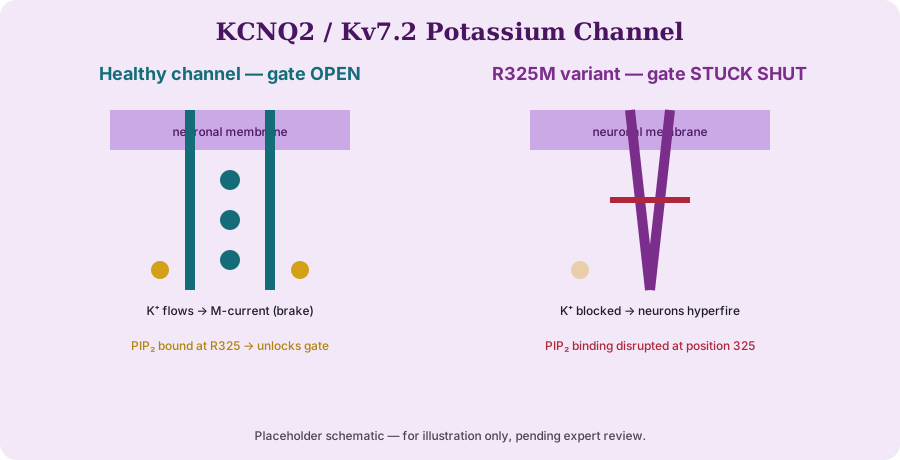
KCNQ2 encodes the Kv7.2 subunit of a voltage-gated potassium channel in neurons. This channel generates the "M-current" — a stabilizing electrical brake that prevents neurons from firing too rapidly. When KCNQ2 is mutated, that brake fails. Neurons hyperfire from birth, causing seizures and — in severe cases — lasting neurodevelopmental delay.
The arginine at position 325 of the Kv7.2 protein sits inside a PIP₂-binding pocket. PIP₂ is the molecular co-factor that "unlocks" the channel gate. The R325M substitution disrupts PIP₂ binding — the gate stays stuck shut. The closely studied neighbor variant R325G, found in multiple patients with severe neonatal encephalopathy, acts through the same mechanism. Violetta's R325M variant has not yet been formally published — representing a direct research gap that Violehealth can fund. Because her variant also exerts a dominant-negative effect (the mutant protein suppresses the healthy copy), gene supplementation via AAV delivery of additional healthy KCNQ2 copies is a scientifically rational therapeutic approach.
Variant Spotlight
Violetta's genetic report, humanized. This is the variant Violehealth is working to characterize and ultimately treat.
VARIANT ANALYSIS REPORT
DE NOVO / PATHOGENIC
Next-Gen Sequencing (NGS)
✓ CLINICALLY VERIFIED
Gene
KCNQ2
Variant
c.974 G>T (p.R325M)
Zygosity
Heterozygous
Inheritance
De Novo
Classification
Pathogenic
Symptom Suppression vs. Disease-Modifying Restoration
Understanding why we fund targeted gene therapy rather than traditional anti-seizure therapeutics.
Conventional Anti-Seizure Medications (ASDs)
PALLIATIVE & SYMPTOMATIC CARE• Mechanism: Non-specific modulation of overall GABAergic or sodium channels to reduce global brain excitability.
• Underlying Defect: Leaves the closed, mutated Kv7.2 potassium channels untouched; does not restore the M-current electrical brake.
• Clinical Limitations: High rate of pharmacoresistance in R325 locus variants, and has little to no impact on long-term cognitive and motor delays.
Targeted Gene Supplementation (Violehealth Focus)
DISEASE-MODIFYING GENETIC MEDICINE• Mechanism: Delivers functional copy sequences of the KCNQ2 gene directly to target neurons via AAV9 capsids.
• Underlying Defect: Directly addresses loss-of-function by restoring normal potassium flow, correcting the electrical brake.
• Therapeutic Goal: Potential to halt seizure activity permanently and rescue neurodevelopmental trajectories during key childhood growth windows.
Investigational Gene Therapy Vector Approaches
Gene Supplementation
Deliver additional healthy copies of KCNQ2 (e.g. via AAV) to restore channel function — well suited to dominant-negative loss-of-function variants.
Suppression–Replacement
Silence the faulty gene copy and supply a healthy, resistant replacement (SupRep) — useful when the mutant protein actively interferes.
CRISPR Editing
Correct the mutation directly at the DNA level. Powerful but earlier-stage for neuronal delivery and precision.
Current Research Landscape
We build on a growing field. The KCNQ2 Cure Alliance supports families and research; XEN496 (ezogabine) has been studied in KCNQ2-related epilepsy clinical trials; and gene therapy programs for conditions like Dravet syndrome offer a model for what's possible. We aim to complement this work — not compete with it.
Sources
Kv7.2 (KCNQ2) channel structure and the M-current — review literature.
R325G neonatal encephalopathy case reports — PIP2-binding pocket mechanism.
AAV gene-supplementation models in neuronal channelopathies.